1 Thought:
Inspired by Wild Company: The Untold Story of Banana Republic.
Remember Why You Started
The Banana Republic Story and the Real Target of Your Work
Every founder begins with a reason.
Not a business plan.
Not a growth projection.
Not a spreadsheet.
A reason.
Sometimes it’s freedom. Sometimes it’s creativity. Sometimes it’s survival. But the companies that become iconic almost always start with something deeper than profit.
That was certainly true for Banana Republic, founded by Mel Ziegler and Patricia Ziegler.
Today the brand sits under the corporate umbrella of Gap Inc., known for polished retail stores and modern upscale clothing. But the original Banana Republic looked nothing like what you see today.
It started with two creatives, $1,500 in the bank, and a strange idea born from adventure.
And the lesson behind their story is one every entrepreneur, founder, and professional eventually faces:
Do you still remember why you started?
Because at some point in every journey, that original purpose gets tested.
The Beginning: A Business Born From Curiosity
Before Banana Republic was a retail empire, Mel and Patricia Ziegler were simply two creatives working at a newspaper.
Mel was a journalist. Patricia was an illustrator.
Both worked for the San Francisco Chronicle. Both wanted something more than routine employment. They wanted the freedom to travel, create, and explore the world on their own terms.
But freelancing quickly revealed a difficult truth: freedom without income is still constraint.
The breakthrough came after Mel returned from a trip with a British military jacket he had purchased overseas. Friends kept asking about it.
Where did you get that jacket?
The question repeated itself over and over.
The jacket wasn’t just clothing. It represented something people wanted: adventure, heritage, and individuality.
That realization sparked an idea.
The Zieglers didn’t write a formal business plan. They didn’t conduct market research.
They simply decided to start a business selling military surplus clothing styled as expedition wear.
They had $1,500.
That was enough.
Their entire business strategy was essentially this:
Find interesting clothing.
Tell a story around it.
Sell it to people who wanted to feel part of that adventure.
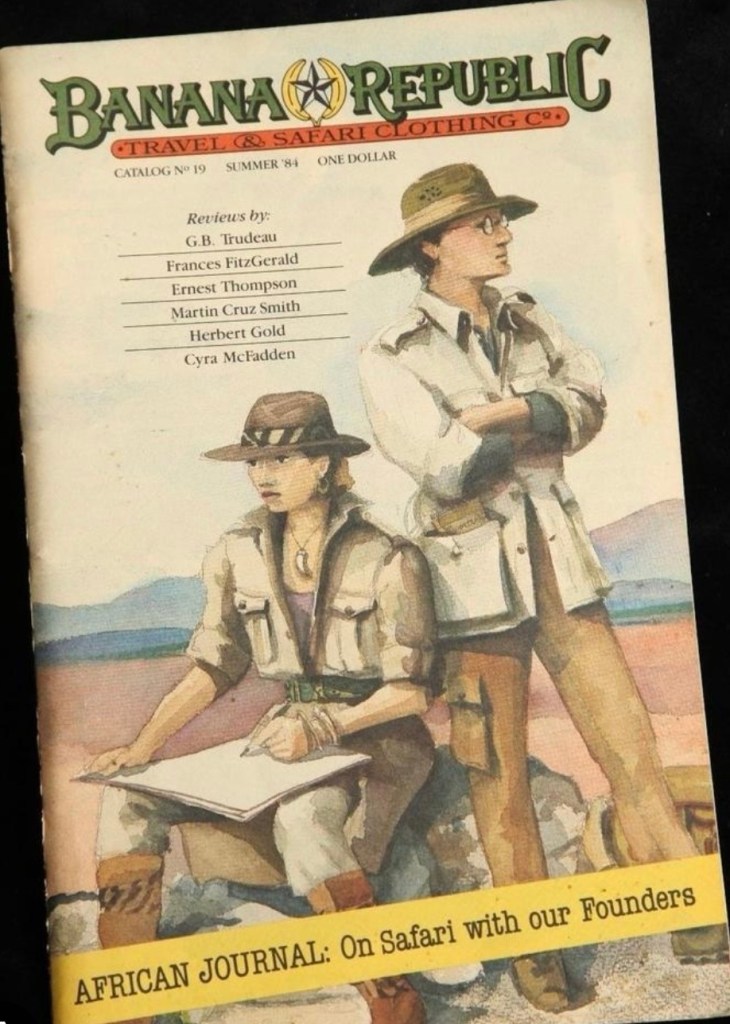
The result became Banana Republic — originally a safari-themed retail world filled with jungle décor, travel stories, and illustrated catalogs that felt more like adventure magazines than advertisements. (remember when I was young getting these catalogs in our mail…would read them cover to cover)
The company worked because it was authentic.
It wasn’t designed by analysts.
It was designed by two people chasing freedom.
“The only asset we had was our own oblivion… blissfully ignorant of the bewildering impediments that would entangle us until quitting was impossible.”
The Real Target Was Never Money
Many people assume entrepreneurs start companies primarily to become wealthy.
The Zieglers were very clear that money wasn’t the real objective.
Freedom was.
They wanted the ability to create the kind of work they loved. To design a brand with personality. To travel. To experiment.
Money simply made that possible.
And ironically, that mindset became one of their biggest advantages.
Because when your only objective is profit, every decision becomes defensive and cautious.
But when your objective is building something meaningful, you’re willing to take creative risks others avoid.
Banana Republic was bizarre by retail standards:
- Safari-themed stores with jungle decorations
- Illustrated catalogs filled with storytelling
- Military surplus reimagined as expedition clothing
- Irreverent branding and humor
No corporate committee would have approved this concept.
But customers loved it.
It felt alive.
And when the Zieglers focused on building a company they believed in rather than chasing profit metrics, something interesting happened.
The profits followed anyway.
“Maybe everybody was happy because we didn’t fixate on profits. Instead, we focused on being a company as good as we wanted to believe we were.”
Growth Creates a New Kind of Pressure
Success changes everything.
Within a few years Banana Republic exploded in popularity. What began as a quirky retail experiment became one of the fastest-growing apparel concepts in the country.
More stores opened.
Demand surged.
The small creative company suddenly required infrastructure: manufacturing, distribution, logistics, scale.
That’s when Gap Inc. entered the picture.
Gap’s founder saw something powerful in the brand and offered to acquire Banana Republic while keeping the Zieglers in control of the creative direction.
At first, the partnership seemed ideal.
Gap provided resources.
The Zieglers maintained their vision. (told they would have total creative autonomy)
It looked like the perfect balance between creativity and scale.
And for a time, it worked.
The company expanded rapidly and became one of the most distinctive brands in American retail.
But success often introduces a quiet danger.
As organizations grow, priorities shift.
Efficiency begins to replace creativity.
Predictability replaces experimentation.
And eventually the question arises:
Should the company remain what it was… or become something safer?
“I’ll buy it, but only if you two stay with it.”
When Corporate Logic Collides With Original Vision
Eventually new leadership inside Gap began pushing Banana Republic toward a different strategy.
The quirky safari concept would be removed.
The storytelling catalogs would disappear.
The adventurous identity would be replaced by a cleaner, upscale fashion brand.
From a corporate perspective, the logic made sense.
From the founders’ perspective, it felt like dismantling the soul of the company.
The tension escalated.
Meetings grew confrontational.
The Zieglers believed they were protecting what made Banana Republic unique.
Corporate leadership believed they were making the brand scalable.
Both sides believed they were right.
But at the heart of the conflict was something deeper than strategy.
It was purpose.
The founders had built Banana Republic to express creativity and adventure.
Corporate leadership saw it as a retail asset to optimize.
Eventually the disagreement became impossible to reconcile.
The Zieglers walked away from the company they had created. (the book describes a very heated meeting between a newly appointed Gap leader and the Ziegler’s…it connected with me and made me respect the couple for how they stuck to what they believed)
And they never looked back.
“The money… was an unexpected byproduct. All along we had been in it for the freedom.”
The Moment Every Founder Faces
What happened to the Zieglers isn’t unusual.
It happens in startups.
It happens in corporations.
It happens in careers.
At some point the reason you started collides with the system you built.
Growth demands structure.
Structure demands compromise.
And eventually you face a decision:
Protect the original vision or adapt to the new reality.
Neither path is inherently right or wrong.
But forgetting the original purpose is where people lose themselves.
Many professionals spend years chasing promotions, revenue targets, or investor expectations only to realize they’ve drifted far from the reason they began.
The Zieglers refused to let that happen.
They walked away from a lucrative position because the mission that originally inspired them had disappeared.
That kind of clarity is rare.
But it’s also powerful.
Because when you know the real reason you started, decisions become easier.
Why Remembering Your “Why” Matters
The story of Banana Republic isn’t really about retail.
It’s about alignment.
The founders built the company to create a life of creativity, adventure, and independence.
When the company stopped serving that mission, they moved on.
Most people never stop long enough to ask themselves that question.
Why did I start this?
Why did I choose this career?
Why did I begin building this business?
Without that clarity, it’s easy to drift into goals that look impressive but feel empty.
Revenue replaces meaning.
Growth replaces purpose.
Activity replaces progress.
The most successful entrepreneurs constantly reconnect with their original reason for building something.
Because that reason becomes the compass that guides every major decision.
“It’s never a straight or smooth road… the bumps and wrong turns stimulate the breakthroughs needed to reach where we want to go.”
The Powerful Lesson From Banana Republic
The founders of Banana Republic didn’t just build a brand.
They built a story.
A story about curiosity.
A story about creativity.
And most importantly, a story about freedom.
They started with almost nothing.
No retail experience.
No formal plan.
Just a desire to create something that reflected their worldview.
That authenticity is what attracted customers.
And it’s why the story still resonates decades later.
But the most powerful moment in their story isn’t the launch.
It’s the exit.
Walking away from something valuable is one of the hardest decisions an entrepreneur can make.
But it becomes possible when you remember what you were really pursuing all along.
The Zieglers weren’t chasing wealth.
They were chasing freedom.
And once the company no longer delivered that freedom, the decision became obvious.
Final Thoughts: The Real Target of Your Work
Every day millions of people wake up and go to work.
Some are building businesses.
Some are climbing corporate ladders.
Some are chasing financial milestones.
But very few stop to ask the question that matters most:
What was the original target?
Not the target the world gave you.
The target you chose.
The reason you started the journey in the first place.
Because if you lose sight of that reason, you can spend years succeeding at something that was never your true objective.
The founders of Banana Republic understood something many people forget.
Success is not simply about building something big.
It’s about building something that aligns with who you are and what you value.
And when those two things drift apart, the courage to reset may be the most important decision you ever make.
1 Quote:
“Creation begins with creating the life you would like to live without fear or inhibition.”
– Zieglers
1 Question:
If you stripped away money, titles, and expectations… what was the real reason you started your journey?
Take 10 minutes today and write down why you originally started your business, career, or project.
Then ask yourself one honest question:
Are your current decisions still moving you toward that original target?
__________________________________________________________________________
P.S. If you like what you are getting from this blog, it would be appreciated if you shared it with other like-minded individuals. The more people that subscribe, the better the comments, and the better we all become from that feedback. I appreciate the support!
FYI… reminder when you subscribe that for your privacy protection you must go to the email you entered and click confirm.
 A Few-Things
Leave a comment